My latest rehab project
You’re not going to believe what crazy thing I did, so I’ll tell you.
I’m the person that gets excited when I stumble across a vintage find that’s got good bones and just needs a bit of a clean-up. Okay, so maybe this one needs a lot of cleaning up.
You see, I’ve been wanting a working Singer 99k 3/4-sized sewing machine for months now. They’re a straight-stitch-only machine, no frills, but oh, they’re built to last! But every time I look at them, there seems to be some sort of major issue with the machine itself or the price is outrageously high. Once I saw one listed for sale and it advertised that it was missing the foot pedal, like what happened? Was it cut off from the electrical cord with scissors or what?!! These babies have their foot pedals hardwired into the machine! But she claims the light turned on. 😳 Hard Pass on the electrocution special. You’ll see the machine so filthy and rusted it makes your skin crawl just thinking about loading it into your car. I get the heebie-jeebies just thinking about that. But some sellers like to use the words “antique or vintage” as if that magically makes them more valuable. First and foremost, rust, dirt, and neglect have never made anything more valuable.
Word to the wise— Never Ever Venmo money up front until you see the item in person with your own eyes and verify that it works!
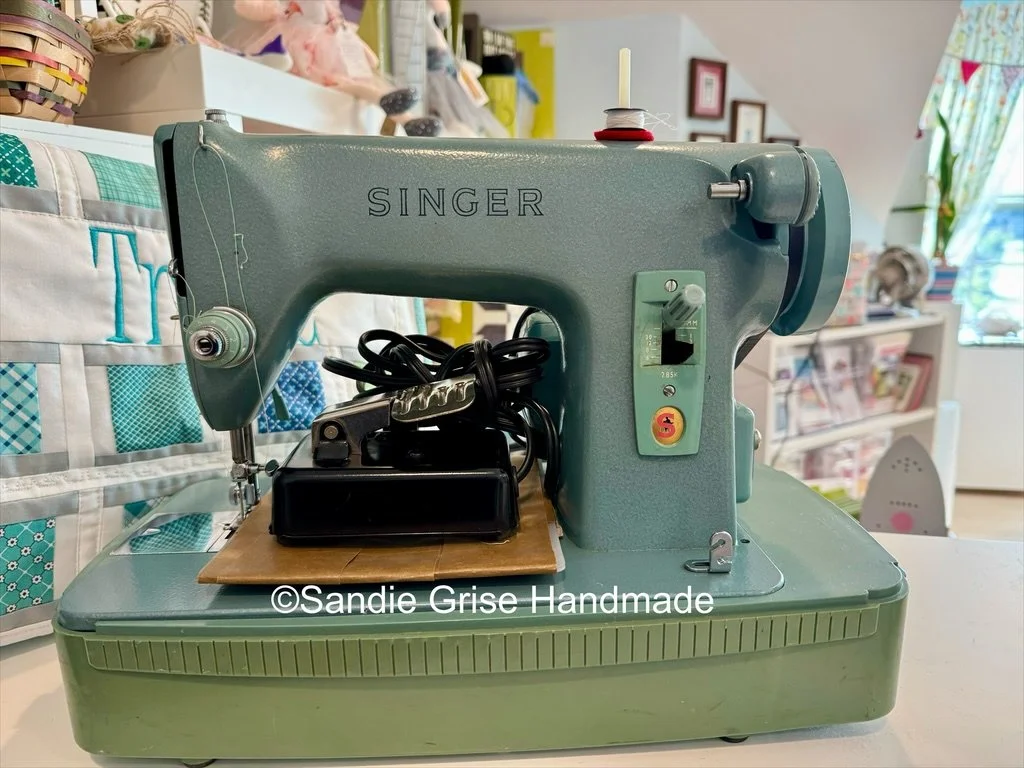
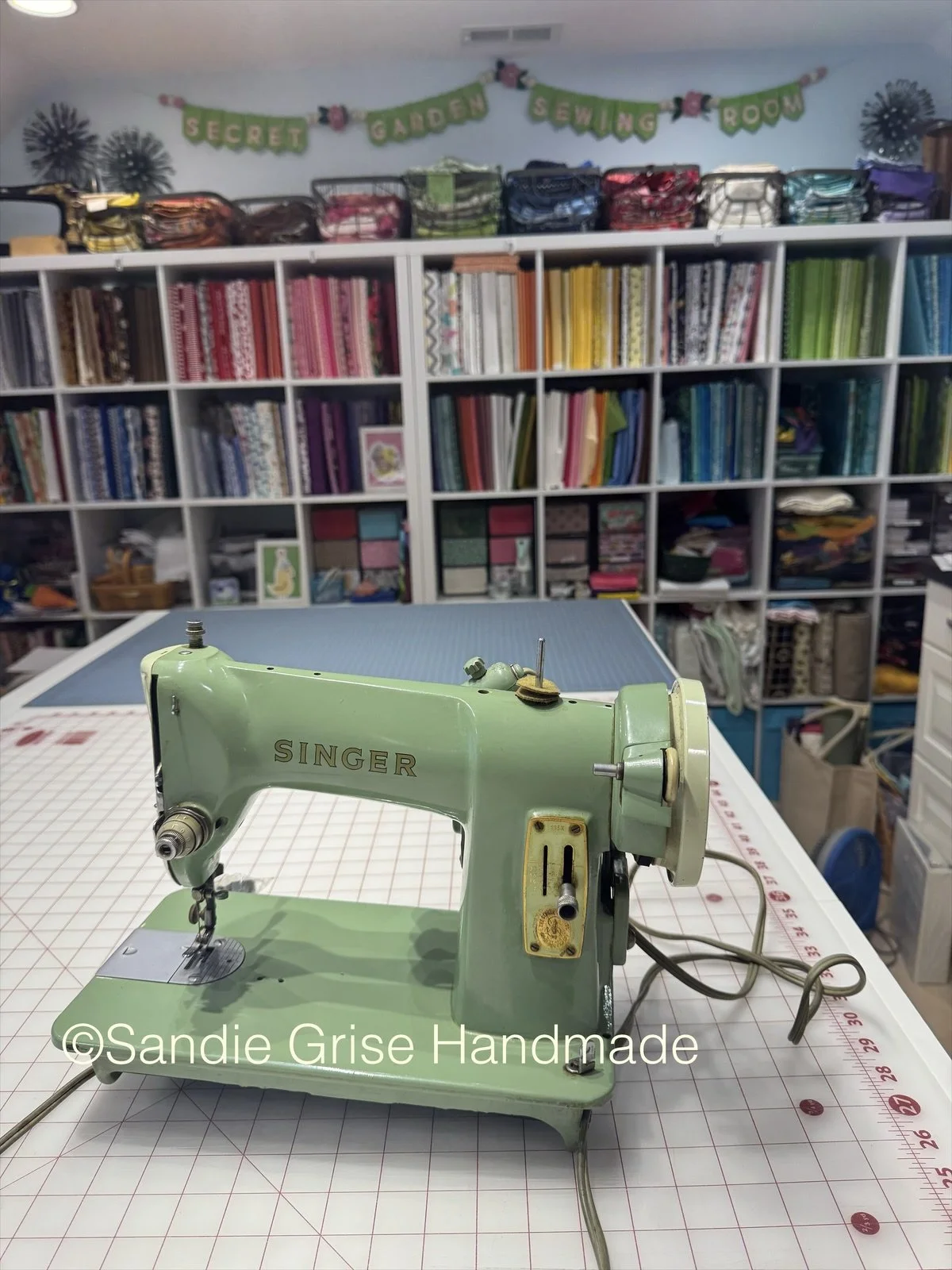
Photo of the top of this post is Pixie, my newest acquisition and rehab project. This is Trixie’s cousin, “Pixie.” She’s a 185k, whereas Trixie is the more modern version at 285k. I’ll go into that later; her photo is at the bottom of this post.
Yesterday I took a chance and I bought this nifty Singer 185K 3/4-sized sewing machine from Facebook Marketplace. While the seller was very sweet, she was also quite honest and admitted to me that she has no idea how to operate a sewing machine. I tested the sewing machine, and it worked; it had all of the parts it’s supposed to have and a few extras. I gladly gave the seller my money, and she loaded my new to me 185K 3/4-sized sewing machine into my SUV. The seller was happy, I’m happy, and I drove back home… happy.
The next thing to do will be to take it apart, then thoroughly clean everything (including the case) and lubricate all of the gears (they’re metal, no plastic here). I’ll have to get my engineer husband to look over the wiring and possibly update it. Although it’s still quite flexible unlike the full-sized Singer 15-91 sewing machine I bought two years ago, that wiring was crunchy, crispy, fried, and all of the wiring had to be replaced.
This little 3/4-sized sewing machine has all those mid-century modern vibes right down to its green coloring. Now don’t go thinking that this machine is like the quilting community favorite, the ever-so-popular Singer Featherweight sewing machine that weighs just 11 pounds. Oh no, this machine is made from cast iron, and she comes in weighing at a whopping 25 pounds! Now I better get a wiggle on with my arm workouts if I’m to lift this little beast on a regular basis. 🤣😂
Here’s a little history…
The Singer 99 was released in 1911 as a portable 3/4-sized version of the full-sized Singer model 66. It ceased being made in 1958 after being in production for 47 years without any changes. In 1958, Singer launched the 185, a restyled version of the 99. With a little facelift and paint job, the 99 became the 185.
The 185 was in production from 1958 to 1963. Depending upon the country where it was made, it is to what color it would be. While mine is green, there are also tan and brown ones out there.
Now let’s talk about Trixie, the 285K. She’s seven and a half years younger than her cousin Pixie, the 185K. I’m copying this next part from internet sources.
The 285 was manufactured from May 1963 through August 1965.
A closely related variant, the Singer 275, was virtually identical except that its foot pedal speed controller was permanently wired into the machine rather than using a detachable 3-pin plug. The Singer 292 shared the same internal framework with minor cosmetic differences.
Evolutionary Lineage and Design Changes
The 285 replaced the earlier Singer 185 model. While the 185 was essentially a cosmetically modernized version of the long-running, all-metal Singer 99K, the 285 introduced a major mechanical departure. Instead of a traditional rotating hook drive, the 285 implemented an oscillating rack and pinion arrangement for the lower hook mechanism under the bed, driven by a Pitman arm from the vertical shaft.
Reception and Legacy
Although the rack-and-pinion update simplified certain timing aspects, it was poorly received by users and technicians. The new underbed geometry made the 285 noticeably noisier and more prone to vibration than its predecessors. Additionally, this era marked an early transition into cost-cutting measures for The Singer Company, featuring non-structural internal components like plastic upper thread tension parts and presser foot lifter levers. Today, it remains a notable and collectible middle-generation vintage machine bridging classic cast-iron framing with shifting 1960s manufacturing economics.
This is just me thinking— the “people,” aka women, let it be known that they didn’t like the 285, and Singer listened to its consumers. That machine was only in production from 1963-65. I’ll be frank, it’s loud, and if you go fast as we sewists sometimes do, it vibrates something fierce.
Fun Facts:
The Singer 185K 3/4-sized sewing machine is the 99K, but in a green dress. While the face plate is different and it’s not wearing a shiny black dress, it’s still the same machine on the inside. The K means that it was made at the Clydebank factory in Scotland.
Like all Singers of their time, you plug them in and go; there’s no off/on switch on them. That’s why I plug into power strips and turn them off.
The “K” designation means that the machine was made at the Kilbowie factory in Clydebank, Scotland. The “J” designation means it was made in Saint John’s (Quebec), Canada.
Side Note— the original case for this machine is MIA. Funny thing, there are hinges attached to the back of this machine; attached hinges mean it once had a home in a cabinet, one that probably had been sold separately. 🫤
Now this baby needs a base to sit in so I can use it. Can you say 3D printer? So now I’m looking at having my husband designing one that he can make using our 3D printer. It could mean a week of making all of his favorite meals as bribery, but I’m up to the task!